How we 3x’ed Google clicks in the past few months
Something special happened in the last two months. Our Google Search Console chart for a wedding DJ booking agency blew up (in a good way).
A year ago, we were getting about 90 clicks a month from Google. The past 28 days: 257. Our average search position went from the low 30s, which is page 3 where nobody scrolls, to 8.4 last week. We did that with zero ad spend and a backlink profile so small (around 34 referring domains) that any SEO consultant would politely wince at it.
For a niche, local service-based business, this has been a game changer for us.
While marketers were stunned, we saw the opportunity
I'm ecstatic because this is all a result of a bet I made this year with myself.
Previously, the business model was built around leads coming from vendor marketplaces like The Knot or WeddingWire. And for years, since this was just a side hustle, that was enough. But growth was stalled. I hired a full-time person to take over the day-to-day, so I could focus on other duties. Which meant it was time to grow.
If you recall, back in Q1 of 2026, you could hear your computer groan every time you opened up LinkedIn, with many exclaiming that thanks to LLMs, SEO was now dead.
So a lightbulb went off in my head … it was time to double down on SEO. Find out what the new rules are and go hard on them so that we're among the early adopters who get to enjoy compounding benefits while the others are stunned and stuck in disbelief.
Now I have documented proof that it's working, and I'm going to share the top things we did that got us the results we're celebrating.
What we'll cover:
Voice-of-customer mining: recording and transcribing 50+ sales calls, then using AI to find the patterns in what couples fear, hope for, and ask
Fear-first marketing: naming the customer's exact fear, validating it, and resolving it with proof instead of promises
Language mirroring: putting customers' own words on the website so it matches what people type into Google and AI assistants
Semantic triples: writing your core facts as plain subject-verb-object sentences a machine can lift and quote
Chunking: structuring every section to stand alone, with the direct answer in the first sentence
Non-commodity content: venue guides and wedding recaps built from first-hand stories, photos, mixes, and playlists nobody else has
Content clusters: looping blog posts, YouTube videos, and location tags into one interlinked body of proof
Interlinking and city pages: niching down from regions to cities and connecting every page to the next
Google Business Profile upkeep: dripping reviews instead of batching them, fixing categories, and posting weekly for freshness
Social media as evergreen evidence: posting for the AI systems that verify you, not the algorithm
FAQs everywhere: live text on every page, written so machines can cite them
Content pruning: deleting dead posts and reinvesting in the ones that work
We started recording the sales calls
One of our couples found us by googling "not lame DJ." I’ll come back to that in a bit. But first, every couple that inquires gets an exploratory Google Meet.
In March we started recording and transcribing those calls (with everyone's knowledge, to be clear). Once we had 50-plus transcripts, we handed the whole pile to Claude and asked one question: what are the patterns?
I've been sitting in these meetings since 2016. So I knew mostly what people said. But seeing it all in front of me as data points and clipped quotes … the marketing ideas suddenly get really easy to spot.
Then we put their words on the website
If couples describe "someone literally on their laptop, just monitoring it," our homepage describes that guy. If they name the Chicken Dance, we name the Chicken Dance. The hero section now opens on the fear instead of a feature, because that's where the couple's head already is when they come to our website.
We call it fear-first marketing, and it has four motions.
Name the exact fear (the Chicken Dance, an empty floor, a mic hog).
Validate it, because the worry is common and reasonable, and they're not being difficult.
Resolve it with proof instead of a promise, which for us means a real review from a real couple answering that exact worry.
And never leave a fear hanging without its answer in the same eyeline.
This made our FAQ section huge. It also rewrote our sales script, and it further helped qualify our leads before we ever talk to them.
Full credit where it's due: Elliott, my co-owner, opens every discovery call by asking couples what they saw at past weddings that they hated. He asks for the negative on purpose. We didn't invent fear-first for the website ... we reverse-engineered it from what he was already doing in the calls.
The part where AI search comes in
You've probably seen the acronyms GEO and AEO floating around this year (Generative Engine Optimisation, Answer Engine Optimisation, and yes, the industry will keep minting these). Strip the jargon, and it means one thing: showing up when someone asks ChatGPT or Google's AI for a recommendation.
Here's why the transcripts matter for that.
People aren't typing "best wedding DJ Omaha" like it's 2019. They're now typing full sentences into Google and AI assistants. And the questions couples type are the same questions they ask us out loud on the calls.
WHICH MEANS: when our website copy mirrors their language, we're not just converting better. We're matching the exact phrasing the machines are trying to answer. The transcript project and the AI search project turned out to be the same project.
Writing so a machine can quote you
This is the year I learned what a semantic triple was.
It is a sentence with a clear subject, verb, and object. A fact a machine can lift out and repeat with confidence. "Alternative Wedding DJs provides nightclub-trained wedding DJs in Omaha, Lincoln, Madison, and Milwaukee." Compare that to the way most wedding vendors write, which is closer to "we bring the vibe wherever the party takes us." A human smiles at the second one. A machine can't do anything with it. No who, no what, no where. So we went through our pages and made sure every load-bearing fact exists somewhere as a plain, extractable sentence: who we are, what we do, where we do it, since when, and what makes us different.
Chunking is the same idea at the paragraph level. AI doesn't present your entire page when presenting info to a human. It grabs passages. So every section has to make sense on its own, ripped out of context: a clear heading, the direct answer in the first sentence, then the story and detail behind it.
That’s why FAQs have become so important. They are the purest version of this. So we put FAQs on all our top pages. Written for couples, formatted so a machine can lift the answer cleanly.
One thing we learned the hard way: it’s best to keep FAQs as live text, not those collapsing accordion menus (Squarespace may be an exception, but still) because some crawlers never expand an accordion.
The test we use now: could a stranger, or a robot, read any single section on our site and walk away with one complete, correct fact about us? If no, we rewrite it.
The venue question
I knew this next bit of information from being in those calls, but it didn't hit me as to how important it was until I saw the data in front of my face.
One question shows up in nearly every single call: "Have you DJ'd at our venue?"
There's a sequencing fact hiding in there. Couples book the venue before the DJ. So by the time they reach us, they already have the venue, and they're nervous about whether their vendors know how to work in those spaces.
For years, we answered this live in the meeting. "Yep, we know that room, we've played it a dozen times." Meanwhile, every piece of AI search research we read kept repeating the same advice: publish non-commodity content. Which means, first-hand experience. Stories nobody else can tell because they are uniquely yours.
So we started publishing venue guides from the DJ's perspective. No one else was doing that.
So we give non-commodity content that only a vendor would know, like where the booth should go. What the room sounds like when it's full versus empty. The rookie mistake we made in there once so the next couple doesn't pay for it. Before a couple ever talks to us, they can read proof that we know their exact room. Once they know that, hiring anyone else starts to feel like the risky option.
Where the content comes from: we interview our own DJs
The weekend after every gig, we now get the DJ on a short Google Meet. How'd it go? What was the venue like? What did it sound like in the room? What songs did you play, and what happened when you played them?
The stories are still fresh, and they're the kind of specifics no competitor can copy. That material flows into the venue guides, and when one wedding gives us enough, it becomes a wedding recap post. We'd already been doing a bit of this. Now we're publishing two to three times more of them.
And each recap comes loaded with stuff only we have. Photos from that wedding. A recording of the actual mix the DJ played that night. The couple's Spotify playlists, which future couples grab as a starting point. Video of the end-of-night circle-up, one song, the whole room around the couple. We don't have to claim we create those moments. There's footage.
Everything points at everything
Our research kept flagging YouTube as one of the most valuable places to publish right now, partly because Google loves citing its own platform. So naturally, YouTube keeps showing up in AI answers.
Every recap gets a video on YouTube. In YouTube Studio, we set the video's location to the actual venue, so it can surface when someone searches that venue. The YouTube description links to the blog post. The blog post embeds the video, linking back to YouTube. The venue guide links to the recap, the recap links back to the guide, and both link to our city pages.
The SEO experts call this a content cluster. I think of it as making sure no piece of our content is ever a dead end. The machines read the loop as one connected body of proof that we know a venue.
The unglamorous stuff
A few more things we changed since March. Less exciting but still matter.
We niched our pages down from regions to cities. We also got aggressive about interlinking, so visitors bounce deeper into the site instead of out of it.
We stopped batching review requests. We used to message a pile of past couples at once and collect eight Google reviews in two weeks, feeling great about it. From Google's side, that spike pattern looks bought, and Google takes a lot of freedom in deciding which reviews it publicly shows.
Now we drip requests steadily, which doubles as a freshness signal: a business getting reviews every week reads as a business doing work every week. While we were in there, we discovered we'd had the wrong Google Business Profile category the whole time (wedding service instead of DJ service), fixed it, added the subcategories we'd ignored, and started posting weekly updates.
We stopped chasing the social media algorithm. Social has never sent us many leads. It's where couples confirm we're legit before inquiring. So we post solid work that stands on its own and stopped worrying about likes, because AI assistants pull from ten places at once before they recommend us, and social is one of the places they check whether we are who we say we are. A post gets maybe 48 hours with the social media algorithm. Now that we treat our content like evidence instead of clickbait, social media content has become evergreen content.
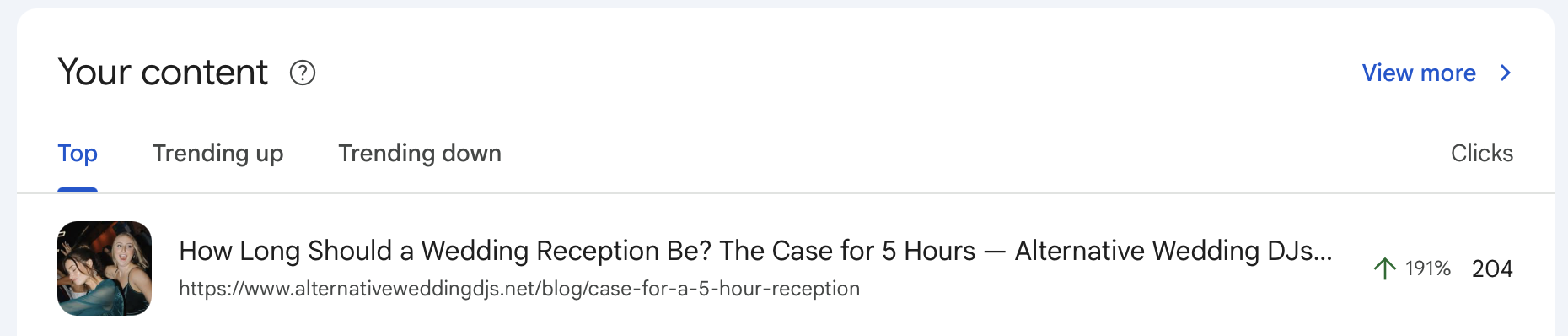
We went through every old blog post and reinvested in what was working. Updated the winners, interlinked them, added first-hand stories, and recorded YouTube videos talking through each one so people can read or watch. Our "Case for a 5-Hour Reception" blog is up 191% over the past 3 months.
You can win without taking risks
Yes, AI is changing search. But there are a lot of dicey strategies people are suggesting out there. Things that work today but could erase your gains tomorrow. The good news is that if you’re willing to be patient (we started this process in April and saw results in July), you can win by doing boring, consistent, old-fashioned SEO.
The twist is that "old-fashioned" now includes knowing how machines read: the plain sentences, the standalone sections, the FAQs, the loops between your blog and YouTube. Nothing risky about any of it. You're formatting your proof so the machines can repeat it.
"AI systems rely on search, and there is no such thing as GEO or AEO without doing SEO fundamentals. Tricks will come out, and they will work for a short time; companies that want to be around for the long term should focus on something that is proven with long-term stability and not tricks." — John Mueller, the Senior Search Analyst at Google
P.S. Twelve couples have told us a pie recipe influenced their decision to book us. But that’s a different post on dropping in surprises in the customer journey. 😆