Make the guide your city uses
Nobody had made an eco-friendly restaurant guide for our city. So we did. Five years later, it's still pulling traffic — and I just spent two days rebuilding it with Claude.
In May 2021, I typed "best eco-friendly restaurants Omaha" into Google, my hometown in America. The results were scattered. I thought, "Perfect.” This was an opportunity.
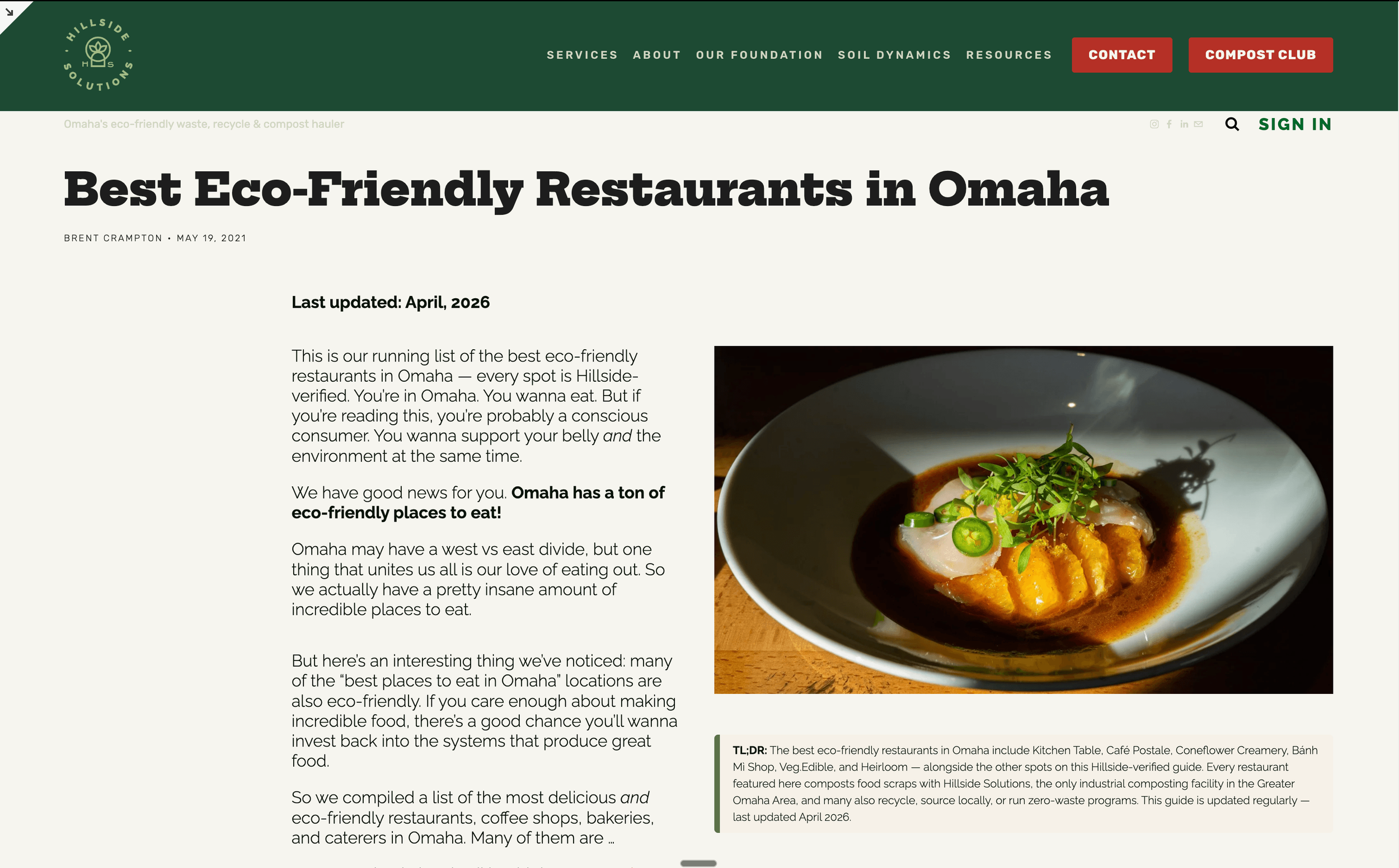
At the time, I was doing marketing and sales simultaneously for Hillside Solutions. The company provides recycling and composting services to local businesses. Meaning, any restaurant serious about sustainability was working with us. I had been in most of those kitchens and had first-hand knowledge of how full their bins were each week.
There was a lot of marketing collateral in that setup. The lazy use of that info would probably make a post about how amazing Hillside was for having all these accounts. Or a blog about how much food waste from restaurants goes to the landfill.
Nobody googles "why should my business compost" before they're ready to buy. But everyone loves a "best places to eat" guide. And since none existed for my specific category, I made it.
Showcase the results of your service. Let your audience find you authentically through that.
That post — Best Eco-Friendly Restaurants in Omaha— has been working ever since. Last year alone it pulled 1,211 unique visits. Time on page averages just under four minutes (which for a directory means people are actually reading it).
It's kept fresh anytime a new restaurant joins. And it’s been used countless times as an evergreen marketing tool to draw people deeper into our world.
It still ranks. Still converts. And every restaurant on it has had referral traffic flow their way for half a decade.
Here’s what I did, and how you can copy it.
Don't make it about your business
Nobody cares what your company did or didn't do. What happened at your team-building exercise or even your new product feature.
Your buyer only cares about themselves.
As soon as you accept that, engagement gets a lot easier.
Make it about them
"So happy we now work with (X) restaurant" now becomes, "Here's a new place you can spend your eco-dollar at."
You still get to brag that your company is growing, but you framed it as a benefit to them. Not a benefit to your revenue.
So your new customer (the restaurant that pays you to pick up its food waste) becomes a destination your blog audience can experience that further expresses their preferred lifestyle (being eco-friendly).
And if that reader happens to mention they came because of the blog, then you just gave your customer a real ROI.
Customer retention. Boosted SEO from dwell time on your website. Giving FOMO to restaurants you don’t work with yet … That thinking is how the guide came about.
Five reasons why this format compounds
Search engines love it. Someone googling "eco-friendly restaurants Omaha" finds your page because nobody else made it. Five years on, ours still ranks. Promotional content decays. Resource content compounds.
The businesses you profile send their customers to your website. Half of the restaurants we wrote about shared the post when it dropped. A few still link to it from their own About pages. Free distribution from the people you wrote about.
Readers spend real time on the page. As I'm sure you can relate to, it takes time to pick where you go out to eat. By the time they finish, they trust your judgment, which means they trust your business.
It deepens the relationships you already have. Every restaurant on the guide is already a Hillside customer — that's the bar to make the list. Profiling them gives me a reason to reach out, send them their direct link to the post, and remind them we're invested in their success. The marketing turns into a relationship-building tool.
Your sales leads get FOMO. When 40+ places in your business category are composting, and you aren’t, it gets you thinking. I had one business owner tell me on the first day of service, “I’m kind of embarrassed I haven’t done this yet.”
At the end of the day, it’s really about the CTA
Six months later, in December 2021, I did the same thing for retail. We published a Zero Waste Gifting Guide — a seven-step pyramid for sustainable holiday shopping, with local businesses woven through every layer. Hand Me-Ups for second-hand. Exist Green for plastic-free goods. It's All About Bees for local honey. Artifact Bags for built-to-last leather. Each one a business that composts with us, recycles with us, or aligns with the ethic.
This guide had one upgrade the restaurant post didn't: a lead magnet at the top of the page. We turned the seven-step pyramid into a downloadable PDF, plus our favourite DIY toothpaste recipe and a homemade spray cleaner. Drop your email, get the bonus content sent to your inbox.
People want it. So they sign up. And then they're on our email list, getting a monthly newsletter from a brand that's spent the whole guide pointing them toward other small businesses they should support.
A directory that grows your email list while it sells someone else's products.
The traffic numbers tell the story. The restaurant directory pulls more visitors. The gift guide pulls fewer — around 240 across the last three years — but holds them on the page for over six minutes in a strong year. People aren't skimming a gift guide. They're working through it, picking which step fits their situation, looking up the local businesses I recommended. And every reader who finds the bonus content useful enough to download it joins a list we'll email for years.
The Playbook
If you're a small food, retail, or hospitality business and you want to run this play, here's the whole method. Six moves. Each one is something I did to my own guide in April 2026 when I rebuilt it after five years.
1. Find the gap
Open Google. Search what your customer would search.
"Best vegan restaurants in [your city]"
"Plastic-free shopping in [neighbourhood]"
"Where to find [niche thing] in [region]"
If the first page is thin, vague, or out of date, you've found your post.
When I ran this in 2021, the top result for "eco-friendly restaurants Omaha" was a four-year-old listicle with one place on it. That was the gap.
2. Pick the angle you have skin in
I couldn't write "best restaurants in Omaha." I'm not qualified to judge that. Eco-friendly restaurants? We literally pick up their compost. We see what's in their bins.
The skin in the game gave me the right to make the list. Without it, the post reads as marketing collateral disguised as helpful content. Readers smell that. So does Google.
Find your version. A wedding DJ company can't credibly rank "best wedding venues" but probably can credibly rank "wedding venues that handle sound well." A restaurant supply company can't rank "best restaurants in Omaha" but probably can rank "restaurants doing the most thoughtful sourcing."
3. Profile fifteen to twenty businesses, not three
Three feels like a top-list. Fifteen feels like a real resource. Length is part of what makes it rank.
Each entry should be:
A square photo, ideally one you took yourself
One sentence on what makes the place worth a visit, written like you're texting a friend a recommendation
A specific operational fact that ties back to your verification framing (mine: "they compost with us," "Compost Club drop-off site," "ditched single-use cups in 2019")
Skip corporate descriptions. The voice is what makes readers stay.
4. Build the funnel into the post
A long post deserves two calls to action, not one — because the reader who scrolls the whole list is a different person than the casual scroller at the top.
Top of page — soft ask: Email signup with the "you'll find out first when a new spot joins" framing. Forces return visits to the post, which compounds SEO over time. Beats a PDF lead magnet, which gets downloaded once and forgotten.
Bottom of page — harder ask: Your D2C service or commercial offering. The reader who reached the bottom has trusted your editorial judgment for four minutes and forty entries. Now's the moment for the bigger ask.
When I rebuilt my guide, the soft ask captures emails for the monthly newsletter. The harder ask drives Compost Club signups, our residential subscription service. Two funnels, two reader states.
5. Distribute through the businesses you wrote about
This is the move most people miss.
Give every business its own anchor link inside the post. Format: /your-post-slug#business-name. So /best-eco-friendly-restaurants-omaha#au-courant jumps a reader straight to that restaurant's section.
Then send each business their direct link. Two sentences: "You're on the list. Here's your direct link if you want to share it."
Half of them will. Some will share it on Instagram. Some will add it to their About page. A few will mention it in their newsletter. Free distribution from people you wrote about. Compounding referral traffic on autopilot.
6. Build for SEO and AEO at the same time
Two different mechanics. Both matter.
SEO ranks the page in Google. Standard moves: meta title and description written for the search intent, alt text on every image in the format "[Business] in [neighbourhood] [city] — [differentiator]," internal links to your service pages worked into the body copy.
AEO gets the page quoted by ChatGPT, Claude, Perplexity, and Google's AI Overviews when someone asks a question. Three moves to add:
A Quick Answer block right after the H1. Two sentences. Short, factual, names dropped in. This is what AI tools extract first.
An answer-anchored opener for each category section. "The best eco-friendly coffee shops in [city] share one thing: [the differentiator]." Then drop into your voice for the rest.
JSON-LD schema — Article markup plus an ItemList of every business tagged with the right schema.org type (CafeOrCoffeeShop, Restaurant, Bakery, IceCreamShop, BarOrPub). The schema type is the part most people skip. Which is great. Now it's your competitive advantage.
Add a FAQ section at the bottom with matching FAQPage schema. Five to eight questions. Real ones readers ask.
What turns it into a five-year asset
The build is the easy part. The maintenance is what makes it compound.
Every business on the list lives in a single source of truth — for me, a Google Sheet. New business meets the bar, I add a row. The blog gets a new entry. The Google Map embedded in the post (high-engagement visual artefact, signals dwell time to Google) gets a new pin. The monthly newsletter announces the addition. The "Last updated" stamp at the top of the post bumps to the current month, mirrored in the schema's dateModified field.
Each update is a freshness signal. Google recrawls. AI tools see the page is current. Social rotation gets a new excuse. The post gets younger every time you touch it.
For major rebuilds, request a recrawl directly through Google Search Console. Don't wait for the bots to find their way back.
A directory that updates itself into the algorithm forever.
The whole approach in one shift
Stop pointing the camera at yourself. Point it at the businesses around you.
Your customers feel the generosity. Your search rankings build over years instead of weeks. And every business you write about owes you nothing — but more than a few will remember.
Want a head start?
I built a Claude skill that runs this playbook end-to-end. It handles the city-gap research, structures the directory, drafts each business profile, plans the lead magnet, and sets up the schema markup so the page actually ranks. If you use Claude, it's a one-line install.
If you build something with it, send it my way — I'll link to it.